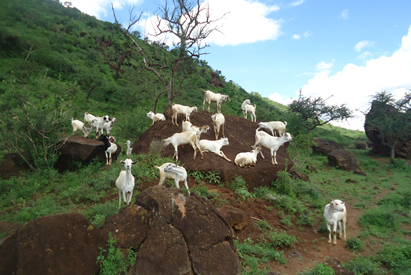
The arid and semi-arid lands (ASAL), representing 84 per cent of the total land mass of the country, remain largely under-exploited due to enduring ways of life by the pastoral communities. There are 24 million hectares in the ASAL that can be used for livestock production, but only 50 per cent of the carrying capacity of the land is currently being exploited. Additionally, there are 9.2 million hectares in ASAL which have the potential for crop production if irrigated. This irrigable area is equivalent to the total farmland in high and medium potential areas in the country. The vision for agriculture sector in the Vision 2030 is, among others, the development of arid and semi-arid areas for both crops and livestock. In addition the goal for 2012 under the Vision 2030 is the development of ASALs, as a strategic thrust with the target being to put an additional 600,000 –1.2 million hectares under irrigation.
Arid and semi arid lands occupy most of the land of Kajiado North District where the main economic activity for the majority of the population is livestock rearing. Kajiado, like other ASALs is prone to erratic and diminishing rainfall and rise in temperatures which lead to loss of pastures and water for livestock. This, coupled with an increasing population and encroachment into dry season grazing lands by neighbouring farming communities, has impacted negatively on the ecosystems of the area and the way of life of the pastoral communities. Frequent droughts and famine necessitate constant food relief support by both the government and donors. It has therefore become necessary that new livelihood strategies and adaptive responses be adopted for survival of these communities. Minimal rainfed crop farming is practiced in areas around Ngong Hills and under irrigation in Ngurumani area of Magadi Division about 150 kilometers from Ngong town.
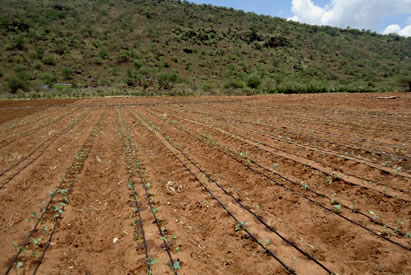
Since 2011 Ekma farm has planted and harvested several crops and vegetables, namely tomatoes, onions, sukuma, spinanch, kunde, beans, maize, sorghum, watermelons, hot chili, passion fruits, green peas, cowpeas, pigeon peas and bananas. In addition over 600 trees have been planted within the farm. The success of this farm has generated interest from the pastoral community that had hitherto believed that crop production could not take place in the area. This interest culminated in a chief’s baraza that was held on 7th February, 2012 at Saikeri trading centre where the local community expressed a wish to be engaged in crop farming though they were constrained by lack of technical knowhow. They also pointed out that this would greatly alleviate their current food shortage. Kajiado district could supply its population with adequate food if the land resource abundant in this area is harnessed in a sustainable way.
Ekma farm supports building the capacities of the target community to develop livelihood strategies that are in harmony with the ASAL environments. Such livelihood strategies will include but not be limited to crop production, agro forestry, water harvesting, pasture conservation, value addition and dry land farming through farmers Field Schools approach. This approach is expected to lead to increase in food availability, promotion of environmental conservation and employment creation.
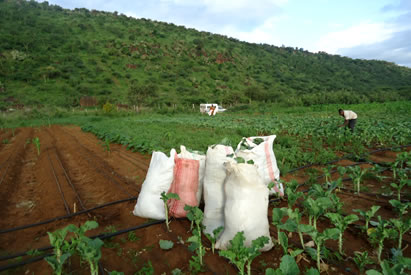
Ekma farm is situated in a low lying area at the foot of Ngong hills approximately 25 kilometers South West of Ngong town near Saikeri trading centre, Saikeri location, Ewaso Kedong Division of Kajiado North District. The farm lies between two ridges occupying an area of 40 acres. The area is characterized by wooden grassland, open grasslands, semi desert bush land and shrubs. The soils are deep sandy loams. The area is at the agro-ecological zone 5 which is suitable for agropastoral livelihood strategies mainly drought tolerant crop farming, water harvesting and livestock keeping. The rainfall pattern is bimodal with short rains being in Oct/Nov and long rains in March/May. Annual rainfall ranges between 500-600mm. The main objective of the farm is to improve food security by increasing food availability through use of irrigation.
The main economic activity in the area is livestock keeping with minimal subsistence crop farming. Farming is hindered by the harsh environmental conditions of low rainfall and the area is prone to frequent droughts leading to relief food distribution by the government from time to time. Environmental degrading activities such as charcoal burning, and overstocking exacerbate the situation. There is however great potential in drip irrigation, greenhouse farming technologies, rangeland rehabilitation, improved livestock breeds and farming of drought resistant crops such as pigeon peas, sorghum and ndengu. Ekma farm wishes to use open field irrigation technologies and quality seeds to produce food for the local communities. Crops produced in the farm will be accessible to the nearby Saikeri and Ngong community in terms of affordable prices, quality and volumes. In addition the farm intends to promote environmental conservation by maintaining a nursery of exotic tree seedlings to be provided to the community for planting during the rainy seasons.
Success of the farm is ensured by adhering to sustainable use of the environment; involvement of the local community through the farmer field school model; use of quality seeds and agrichemicals from distinguished firms.
Main objective
The main objective of the farm is to improve food security by through commercial growing and encouraging the local community to adopt crop production technologies
Specific objectives
The specific objectives are to;
- Support the local community in food to enable them grow their own food;
- Promote environmental conservation; and
- Promote value addition to both crop and livestock produce.
The Strategy
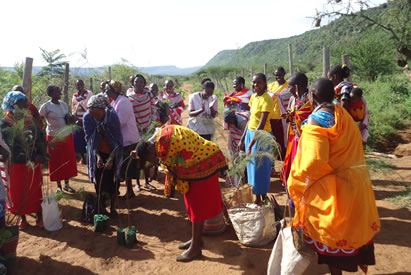
The proposed strategy is ‘farmer field school’ approach where groups of farmers will be selected through a participatory process and be taken through crop production, environmental conservation and value addition. Trainings, demonstrations, field days and tours will be conducted to expose the trainees on practical applications of the selected technologies.
Economic potency
The main economic activities in the area are livestock keeping with minimal subsistence crop farming. This is brought about by the harsh environmental conditions of low rainfall, high temperatures and poor soils. The area is prone to frequent droughts leading to relief food distribution by the government from time to time. Environmental degrading activities such as charcoal burning, sand harvesting and overstocking exacerbate the situation. There is however great potential in rangeland rehabilitation, improved livestock breeds, water harvesting for crop production, drip irrigation and greenhouse farming technologies.
Social structure
The area is mainly occupied by the Maasai community with the recent influx of people from other communities. The main economic activity is subsistence livestock keeping with low potential livestock breeds. Traditional customs still play a big role in the way of life of the community and family ties, both nucleus and extended family ties are still being valued. Authority is still vested on elders and the government through the provincial administrators (chiefs). Social amenities are scarce and accessibility to the area is hampered by poor roads leading to high food prices.
Justification/rationale
The frequent droughts occasioned by failure of rainfall and the resultant famine in the area creates a situation where the community is food insecure and a lot of time and energy is spent on trying to satisfy this need. It is imperative that strategies be put in place either by the community or individual entrepreneurs that will exploit the environment in a sustainable way and produce food for the inhabitants. Food produced at Ekma farm will be accessible to the community in terms of affordable prices, quality and volumes. Currently, food at Saikeri trading centre is expensive, of low quality and not always available since it has to be imported from Ngong town. The farm intends to increase crop production, promote environmental conservation as well as create employment for the locals.